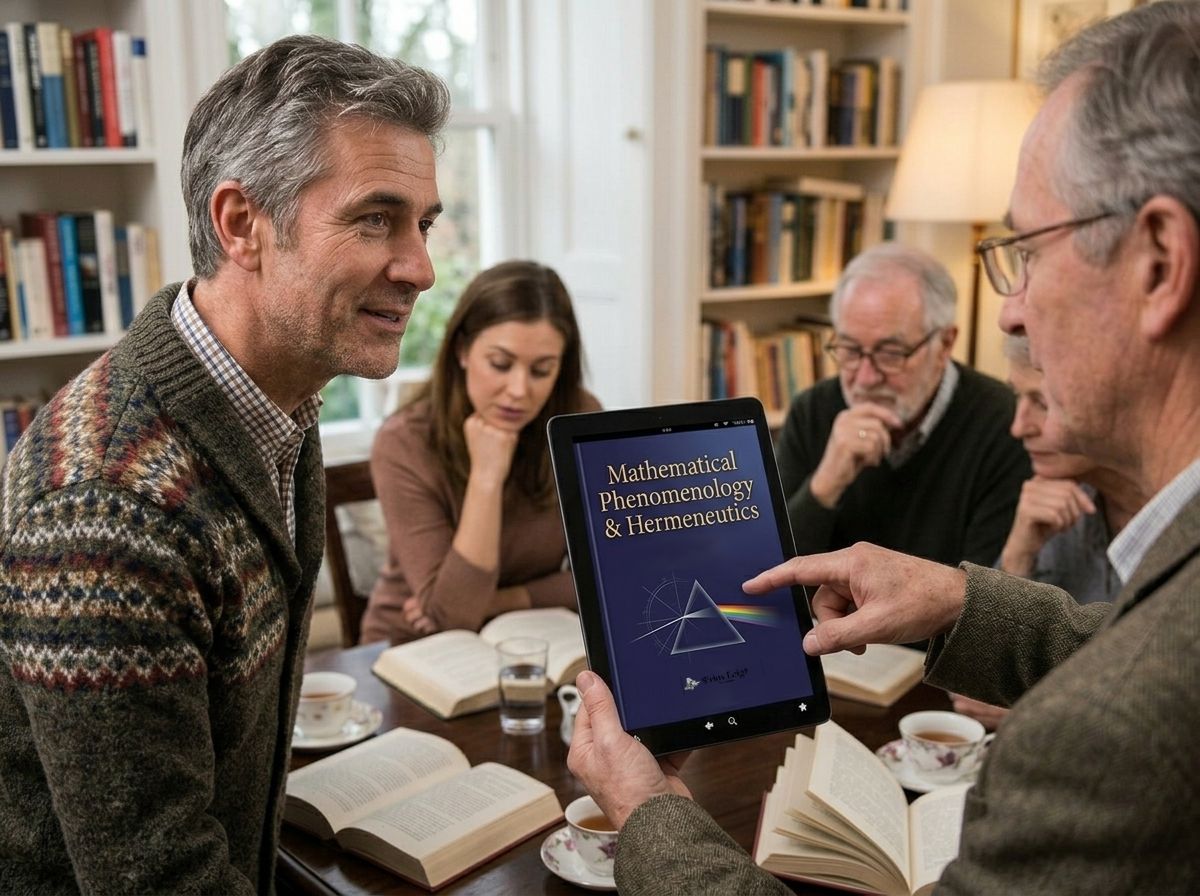
Mathematical Phenomenology & Hermeneutics
A Field of Inquiry Into the Lived Experience of Mathematics
Mathematics is usually presented as external: a system of symbols, rules, and proofs that stand independent of the human beings who explore them. Yet anyone who has ever wrestled with a theorem, glimpsed the elegance of a pattern, or felt the shock of sudden insight knows that mathematics is not merely a body of knowledge. It is an experience.
A sensation. A field of meaning that unfolds inside the mind as much as it describes the world outside it.
Mathematical Phenomenology and Hermeneutics (MPH) is the study of that interior landscape.
MPH is an interdisciplinary framework and emergent field developed by Sirius Leigh Peter to map the architecture of human consciousness and spiritual experience using mathematical structures. Formally, it is defined as the study of how consciousness expresses mathematically describable structures and how those structures reveal meaning across psychological, symbolic, and spiritual domains.
The framework was originally created to provide a geometric coordinate system for discussing experiences of God without devolving into endless arguments or falling into the “black hole of dialectics”. To accomplish this, MPH establishes God as the “Core Axiom” and synthesizes three major concepts:
- Mathematics as Ontology: In MPH, mathematics is repositioned from a static, rigid tool of calculation into a living language of action and the foundational language of the psyche. It views mathematics not merely as a metaphor, but as a system that translates the activity of nature and models the behaviors of lived experiences. For example, MPH uses sine waves to model the motion of life, fractals to describe recursive identity, and imaginary numbers to represent unseen axes of the self.
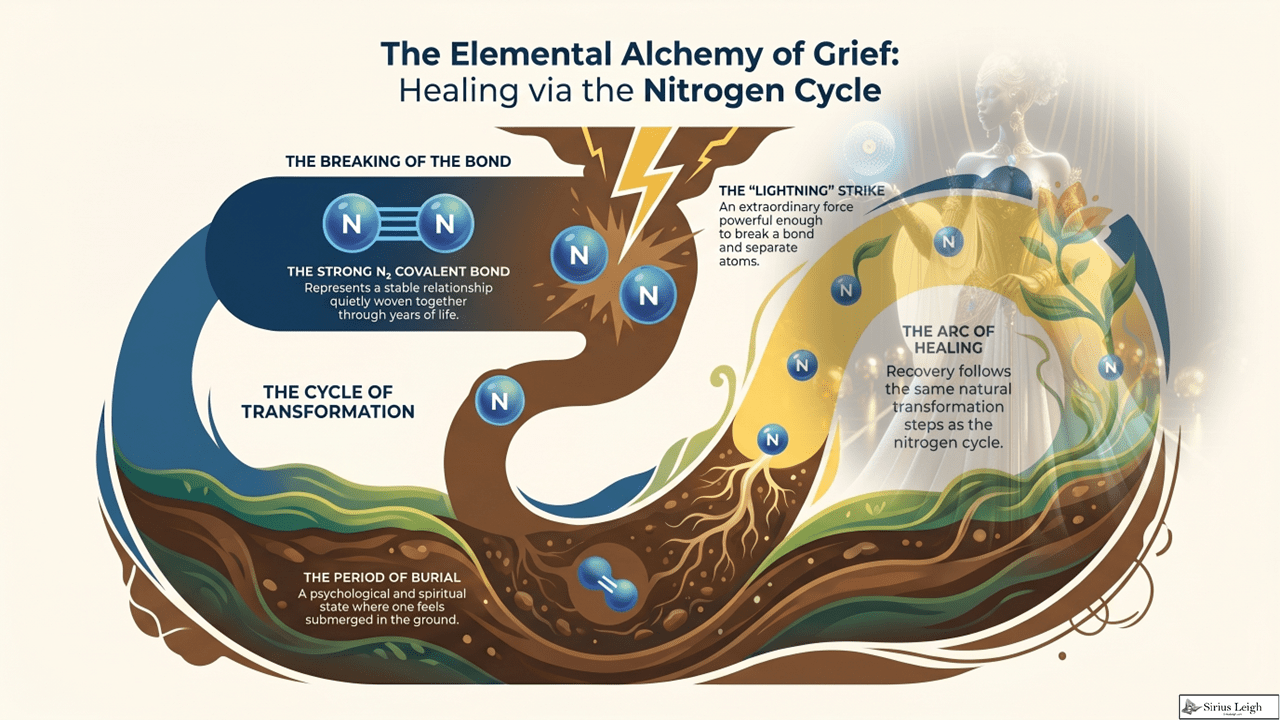
- Phenomenology as Method: While classical phenomenology studies how lived experiences appear to our consciousness, MPH extends this by arguing that experiences also possess specific mathematical forms. It studies the actual “shapes” of life events, observing that grief behaves like a “topological rupture,” insight mirrors “wave interference,” and transformation looks like a mathematical limit approaching its boundary before breaking into a totally new domain.
- Hermeneutics as the Interpretive Bridge: Traditional hermeneutics focuses on interpreting texts, but mathematical hermeneutics interprets these mathematical undulations and structural events. It acts as the bridge connecting the mathematical form of an experience to its profound meaning. Through this interpretive lens, things like scripture, myths, parables, and cognitive dissonance become measurable data points mapped into a larger, meaningful system.
Ultimately, MPH aims to serve as a non clinical comprehensive tool for mental well-being, helping individuals understand and safely navigate their own “cognitive undulations” and mental arcs rather than compressing them into conventional psychological categories.
It integrates a wide array of disciplines: including cognitive neuroscience, complexity science, theology, chemistry, and psychology, not to blend them together, but to interpret the precise points where they intersect and converge.
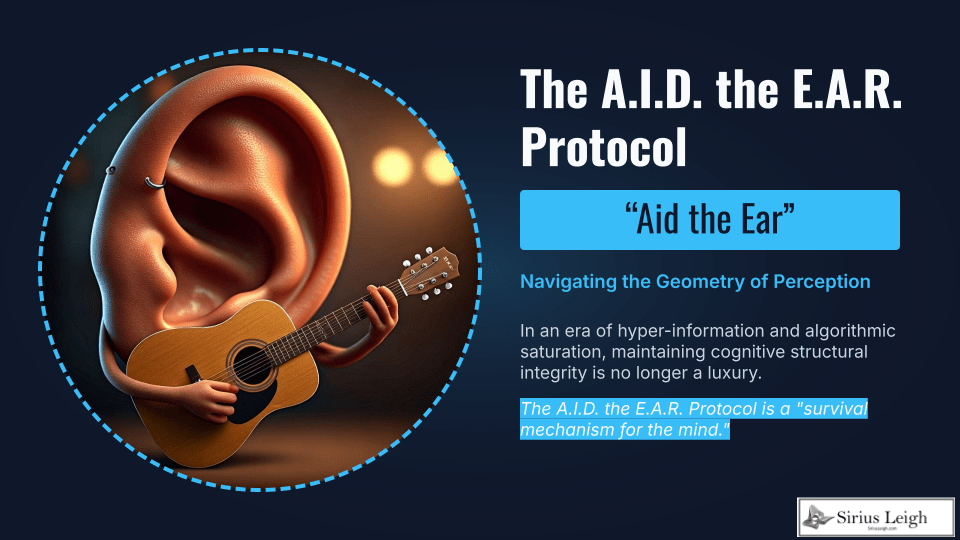
Because engaging with abstract and spiritual domains carries the risk of apopheniaApophenia is the term used for the tendency to perceive meaningful connections between unrelated things. We tend to use it More (finding false patterns or meaning where none exists), MPH employs a a non clinical diagnostic safety protocol called A.I.D. the E.A.R.. This filter trains the practitioner to separate the core underlying truth (AllusionAn allusion (not to be confused with an illusion) is a literary device where a writer or artist makes an More) from its sensory presentation (Illusion), ensuring the mind does not collapse into a catastrophic misunderstanding of reality (Delusion)
Why This Field Matters Now
We live in a moment when mathematics governs nearly every aspect of modern life, yet few people understand how mathematics actually operates inside the human mind.
Mathematical Phenomenology & Hermeneutics offers a lens that reconnects mathematical thinking with human meaning. It honors intuition as part of formal reasoning. It acknowledges that mathematical insight is embodied, emotional, and cognitive all at once.
This field is especially relevant for those exploring:
- consciousness studies,
- philosophy of mind,
- theological interpretations of order and pattern,
- creativity and problem-solving,
- the inner life of scientific discovery.
Mathematical Phenomenology & Hermeneutics provides language for the “interior mathematics” that has guided mystics, scientists, and artists for centuries but has rarely been named.
A New Frontier of Inquiry
To study mathematics phenomenologically is to ask: What is it like to encounter truth?
To interpret mathematics hermeneutically is to ask: How does that encounter reshape the world?
Together, these two approaches form a discipline that treats mathematics as both experience and interpretation—both perception and meaning-making. It recognizes mathematics as a mode of human consciousness, not just a tool of calculation.
Mathematical Phenomenology & Hermeneutics invites readers, thinkers, and seekers to explore mathematics as a living encounter… one where inner perception and outer form illuminate each other in surprising and transformative ways.