Scully Mulder Math
Long before binge culture, there was The X-Files. A moody, cigarette-smoke stained odyssey of government conspiracies, extraterrestrials, cryptids, and the terrifying possibility that reality might be stranger than the official report. Beneath the aliens and autopsies, however, lived a much more enduring tension: two minds attempting to navigate the unknown from opposite directions.
Dana Scully was science.
Fox Mulder was belief.
Or at least that’s how the story was packaged.
But Mathematical Phenomenology and Hermeneutics has a habit of interrogating packaged binaries. Once you look closely enough, opposites often reveal themselves as neighboring coordinates pretending to be enemies.
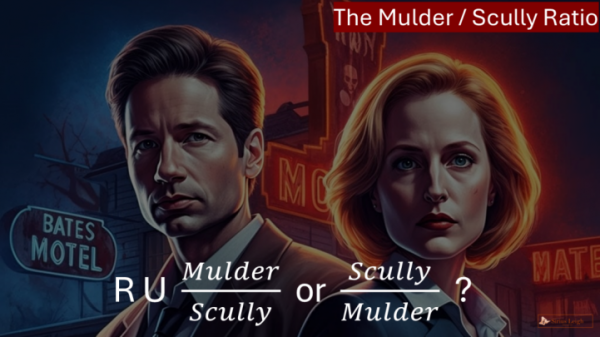
Mathematically speaking, Dana Scully was 22/7.
Fox Mulder was π.
At first glance the distinction seems obvious. One is rational; the other irrational. Everyday language encourages us to treat those words morally rather than mathematically. Rational means sensible, stable, trustworthy. Irrational means emotional, unreasonable, unstable.
But mathematics says something much stranger.
A rational number is simply a number that can be expressed as a repeating ratio. Its decimal expansion eventually settles into recognizable recurrence. Predictable behavior. Pattern closure.
An irrational number behaves differently. The expansion never repeats. No visible closure emerges. The digits continue beyond compression.
And yet π remains one of the most dependable constants in mathematics.
This is where the homonym fractures open.
In ordinary speech, irrationality suggests unreliability. In mathematics, irrationality simply means the decimal expansion cannot be fully reduced into repeating form. The number still functions. The geometry still holds. Circles do not collapse because π refuses repetition.
That sounds an awful lot like Mulder.
Mulder trusted patterns before he could completely prove them. He moved through intuition, synchronicity, symbolic resonance, and the suspicion that reality exceeded institutional explanation. To the cynical mind, this appears dangerous because the irrational cannot be fully stabilized. There is always another decimal place waiting in the dark.
Scully, however, functioned like 22/7: practical, measurable, disciplined, and extraordinarily close to the truth. That closeness matters. Engineers use approximations constantly because approximations perform. They stabilize construction inside the physical world.
And that is why Scully and Mulder worked so well together.
Scully was never truly opposing Mulder.
She was orbiting the same circle through rational approximation.
Mulder chased the infinite expansion. Scully demanded reproducibility. One pursued emergence; the other required verification. Yet both were describing the same geometry from different epistemological positions.
The cynic misunderstands this dynamic entirely.
CynicismCynicism is emotionally toxic and cynics are tainted hypodermics administering the toxicity. Interaction in the real world will create a More prefers false binaries because binaries eliminate responsibility for discernment. Choose science or spirituality. Logic or intuition. Evidence or wonder. Scully or Mulder.
But reality rarely behaves so cleanly.
Science itself depends upon irrational constants. Every circle, wave, orbit, and oscillation already contains quantities that cannot be completely compressed into repeating certainty. The measurable world is quietly constructed atop irrational foundations.
That realization changes the emotional meaning of the word irrational entirely.
Perhaps the problem is not that reality contains irrational structures.
Perhaps the problem is that modern consciousness has been conditioned to distrust whatever refuses immediate closure.
This is one reason A.I.D. the E.A.R. becomes necessary within Mathematical Phenomenology and Hermeneutics. The modern mind swims in symbols, signals, algorithms, allusions, media loops, archetypes, and emotional contagions. Pattern recognition alone is not wisdom. Human beings can impose meaning onto almost anything. The question is whether the perceived pattern survives contact with reality itself.
Truth in Performance.
That is the test.
Some allusions collapse under pressure. Others continue revealing structure decades after they first enter culture. The X-Files survived because beneath the paranormal entertainment was a legitimate philosophical tension about consciousness and perception.
Scully fears false positives.
Mulder fears false negatives.
One fears believing too quickly.
The other fears dismissing truth before it can be recognized.
Between them stands the modern human mind rotating around its own unit circle of skepticism and belief.
This is where Silencing the Cynic enters the conversation.
The cynic is neither Scully nor Mulder.
The cynic is the voice demanding endless rotation without commitment. Endless suspicion masquerading as intelligence. Endless traversal around the circumference while mistaking motion for progress.
Scully investigates.
Mulder seeks.
The cynic stalls.
And perhaps that is why the series resonated so deeply across generations. Not because audiences necessarily believed in aliens, but because most people secretly recognize the war between these two modes of perception inside themselves.
One side demands proof before movement.
The other senses movement before proof arrives.
Both are trying to navigate uncertainty without losing their minds.
The truth is out (T)here.
The question is whether your consciousness possesses the discernment to approach it without collapsing into either blind cynicismCynicism is emotionally toxic and cynics are tainted hypodermics administering the toxicity. Interaction in the real world will create a More or untethered drift.
Or perhaps the deeper realization is this:
22/7 and π were never enemies.
One was the rational approximation.
The other was the irrational expansion.
But both belonged to the same circle the entire time.