The Pink Cloud Threshold
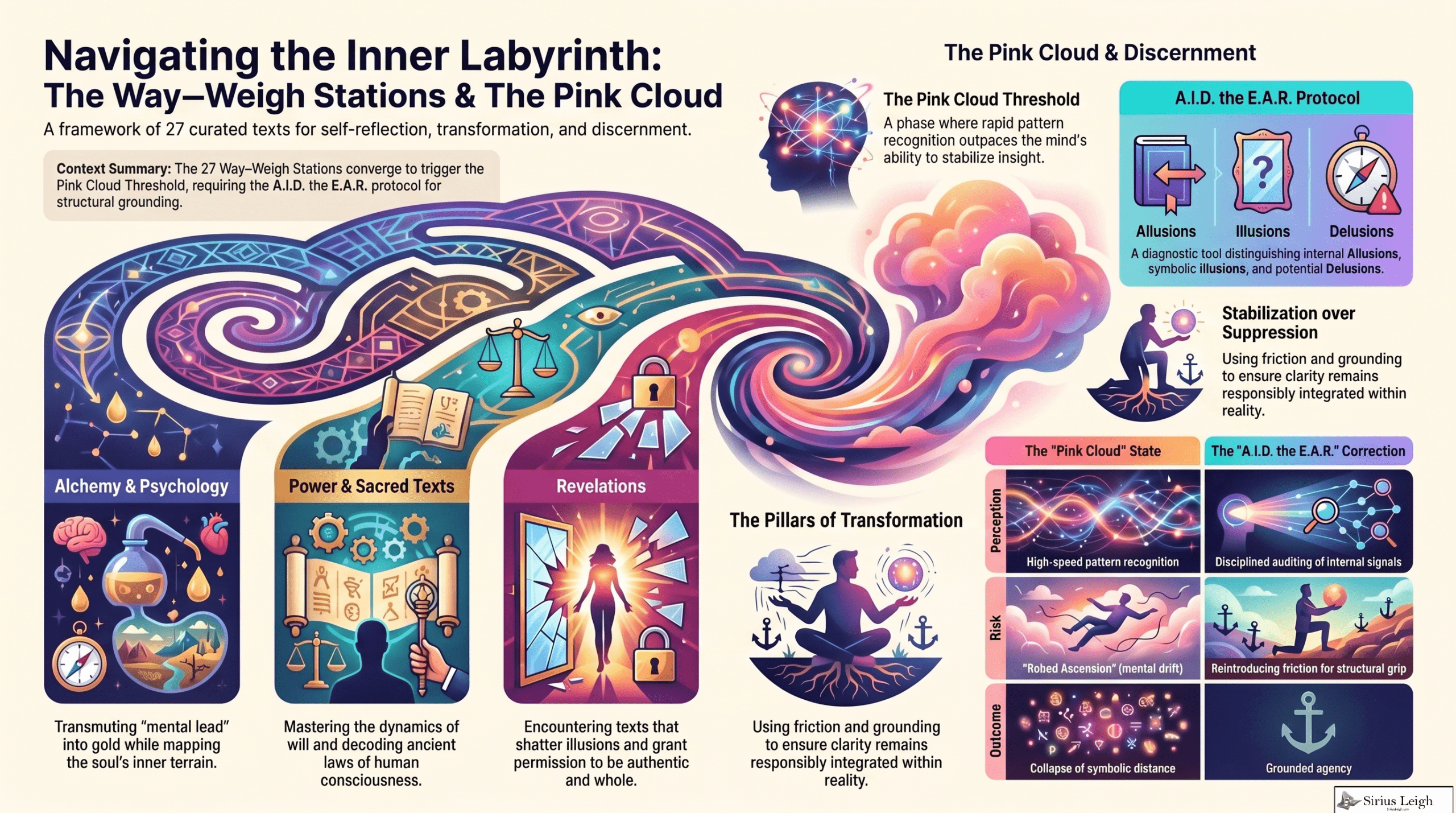
The Pink Cloud Threshold is a predictable developmental phase that emerges when an individual is immersed in high-density meaning across multiple systems at once – such as reading the 27 Way-Weigh Stations.
It is not a pathological condition or a failure of the seeker; rather, it is a sign that the mind has encountered more meaning than it has yet learned to hold without distortion.
The Sensation of Clarity: It does not announce itself as a danger, but feels like profound clarity. Insights begin to stack, patterns align across different frameworks, and abstract texts suddenly feel deeply immediate and personal. It creates the sensation that everything is speaking the exact same language.
The Core Imbalance: The threshold is reached when the rate of “internal activation” expands faster than a person’s “disciplined interpretation”. In other words, an individual’s ability to recognize profound patterns grows much more rapidly than their ability to contextualize, stabilize, or translate those insights. This results in a temporary imbalance between perception and discernment in a highly allusive environment.
The Sensation of Power: Because the individual realizes they can hold multiple frameworks at once and see patterns others miss, they develop a heightened sense of mental agency and cognitive authority. This can create an intoxicating pull toward transcendence, leading to what the author calls “floating off into my personal robed ascension”.
The Risk of “Drift” and Delusion: When everything feels universally connected and personally relevant, the mind loses friction. Boundaries blur, and the individual may begin to treat all symbols as direct truths, collapsing the necessary distance between an idea and reality. Furthermore, the individual often feels a strong impulse to externalize and share their ungrounded clarity with others, which frequently results in confusion and interpretive breakdown because they lack a shared coordinate system.
You can tell if you are experiencing the “pink cloud” phase by monitoring your internal sensations, how you process symbols, and how you interact with others. Because pink clouding does not announce itself as a danger but rather feels like profound clarity, you have to watch for specific signs of perceptual imbalance:
1. The Sensation of Universal Connection You feel an intense spike in insight where patterns rapidly align across entirely different frameworks. Abstract concepts or ancient texts suddenly feel immediate, precise, and deeply personal. If you feel that everything is speaking the exact same language and everything is personally relevant, your internal activation is likely outpacing your interpretive discipline.
2. An Intoxicating Sense of Power Because you can suddenly see patterns others miss and hold multiple frameworks at once, you will experience a heightened sense of mental agency. You can tell you are pink clouding if this power creates an intoxicating pull toward transcendence—a desire to rise above the noise of the world, which the author describes as drifting into your “personal robed ascension”.
3. The Urge to Over-Communicate A major symptom is the impulse to immediately externalize your newfound clarity. You may feel a strong urge to explain, correct, or share your insights with people who have not undergone the same perceptual shift.
4. Relational Friction and Misunderstanding Because you are trying to share complex internal signals without calibrating your delivery, your communication will fail. If your attempts to share your clarity consistently generate confusion, resistance, or dismissal from others, you are likely transmitting without a shared coordinate system.
5. Blurring Boundaries and Loss of Friction When pink clouding, your mind loses its necessary friction. You can identify this if you notice contradictions softening and boundaries blurring. Specifically, you will start treating metaphors as literal mechanisms and symbols as direct truths, collapsing the necessary distinctions between an idea and reality. Ultimately, your “understanding becomes identification”.
If you notice these signs, it is not a failure; it simply means your mind has encountered more meaning than it has yet learned to hold. You can stabilize this phase by using a protocol like A.I.D. the E.A.R. to reintroduce friction, audit your interpretations, and calibrate how you communicate with others
To develop the “disciplined interpretation” necessary to survive the Pink Cloud Threshold, you must intentionally reintroduce “friction” into your thinking process. During this phase, the mind tends to lose friction—boundaries blur, contradictions soften, and you risk treating metaphors as literal mechanisms.
To counter this, you must stop passively receiving meaning and instead actively structure your insights using the A.I.D. the E.A.R. protocol. You can build this discipline through the following four practices:
1. Run the E.A.R. Audit on Every Insight When you experience a sudden spike in clarity or recognize a profound pattern, pause and ask yourself these specific diagnostic questions:
- Experience the AllusionAn allusion (not to be confused with an illusion) is a literary device where a writer or artist makes an More: Ask, “What is being activated in me?”. Acknowledge the valid internal signal or felt realization.
- Analyze the Illusion: Ask, “What is the vehicle carrying this meaning?”. Critically evaluate the symbol, metaphor, or sensory presentation that is delivering the concept to ensure it is broadcasting insight rather than incitement.
- Rebuke the Delusion: Ask, “Am I interpreting this in a way that maintains coherence?”. Ensure you are not mistaking the symbolic vehicle for absolute truth. By maintaining the distance between an idea and reality, you earn “discernment,” which prevents symbols from turning into idols or dogma.
2. Perform a Navigation Check Disciplined interpretation requires a stable coordinate system. When evaluating a new idea, ask yourself: “How does this fit with my core axiom?”. By choosing a core truth to serve as an unquestioned starting point (such as treating “God as Axiomatic” or adopting the mindset of “the mind of Christ”), you give your mind a compass to navigate abstract or esoteric terrain without drifting into absurdity.
3. Use the Material as an Identity Checkpoint You must refuse to consume information passively. To truly “weigh” yourself against these stations, you must actively interrogate how the material is changing you by asking:
- What do I believe after reading this?.
- What am I adopting?.
- What am I projecting?.
- What am I misunderstanding?.
- Can this be grounded?.
4. Practice Relational Discipline Finally, disciplined interpretation applies to how you communicate with others. You must recognize that internal clarity does not automatically translate to shared understanding. Before externalizing your insights, you must carefully calibrate your delivery to match the listener’s frame of reference. Furthermore, you must develop a tolerance for “asynchronous recognition”– meaning you accept that insight cannot be forced on others and that proper timing is required for a signal to be accurately received.
By consistently applying these steps, you build the structural grounding required to hold high-density meaning without distortion, inflation, or collapse.
To survive the Pink Cloud Threshold, the individual must use a stabilizing mechanism (like the A.I.D. the E.A.R. protocol) to reintroduce friction. This structures the influx of meaning, allowing the person to stay grounded and turn rapid insight into mature, responsible discernment.