Mathematics in Motion
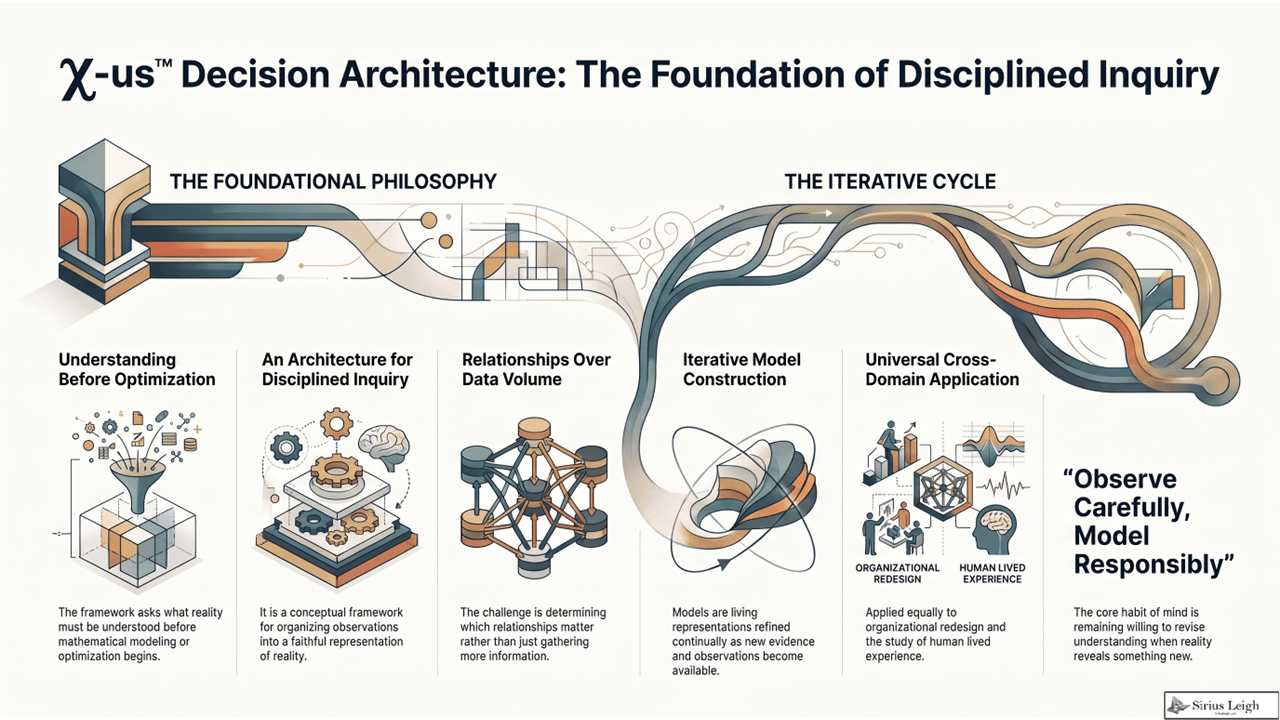
The χ-us™ (kye-us) Decision Architecture
People sometimes ask what I do when I’m not writing about MPH, studying Scripture, or disappearing down another mathematical rabbit hole. The answer is much less mysterious than most people expect.
Mathematics is my day job. More specifically, I build mathematical models that help organizations make better decisions. Businesses constantly face questions about staffing, scheduling, inventory, profitability, logistics, customer behavior, and long-term planning.
My work is helping leaders understand those systems well enough to make thoughtful decisions before small problems become expensive ones. The funny part is that, in hindsight, this probably explains MPH better than anything else.
When my husband died, I didn’t suddenly become a different person. I simply reached for the tools my mind had been using for decades. When in doubt, we tend to use what our minds are already made of. Mine happened to be made of mathematics, systems thinking, language, and an unhealthy number of thought experiments.
Eventually, those same habits of observation that I had applied to organizations found their way into the study of grief, perception, and meaning. The subject changed. The methodology didn’t.
So if you’re curious about the mathematical side of my work, or you’ve wondered where some of the systems language in MPH comes from, I’d like to introduce you to my other world…
Decision Design Science.
A Different Way of Thinking About Organizations
Decision Design Science is the study of how better systems produce better decisions, and how better decisions produce better systems.
Organizations make decisions every day.
Some decisions involve hiring employees.
Others involve inventory, scheduling, pricing, transportation, marketing, expansion, or customer service.
Although these decisions may appear unrelated, they all share something in common.
Each requires balancing limited resources against competing objectives while operating under real-world constraints.
This is the domain of Decision Design Science. Rather than viewing organizations as collections of independent departments, Decision Design Science views them as interconnected systems whose performance depends upon the relationships among people, processes, information, materials, technology, and time.
The goal is not simply to solve isolated problems.
The goal is to design systems that make better decisions.
The case studies aren’t an attempt to sell consulting services, but an opportunity to observe the habits of thought that eventually made MPH possible.
These case studies are simply one expression of that disposition. If you’ve ever wondered how a mathematician eventually found herself writing about phenomenology, language, Scripture, grief, and the architecture of consciousness, this is part of the answer. This is what my mind was already doing Monday through Friday.
Whether the system under consideration is a tea company, a healthcare agency, a retail business, or something far more personal, the underlying questions remain remarkably consistent.
- How does this system behave?
- What assumptions define it?
- What relationships matter?
- Where is it drifting?
- And what might become possible if we learn to see it more clearly?
Course Outline
- A Note About these Case Studies
- Decision Design Science and Operations Research
- Mathematics Beyond the Classroom