The Beginning
I considered many ways to begin.
I worried for a long time about how the end or at least, how my end of things might be perceived.
But now I realize: I wasn’t ready to begin until I no longer cared about perception at all.
Some will feel this story deep in their bones as a journey toward the Kingdom.
Others will dismiss it as the psychological breakdown of a widow.
From where I stand, both are true.
I did break down.
And in the ruins, I sought the Kingdom.
After my husband died, I played the part.
I dove into the expected rituals of grief.
I talked it out. I “worked through.”
Because that’s what “healthy, rational” people are supposed to do, right?
You find a counselor. You stay busy. You try to move forward. You keep the machine of life rolling.
But about three months after he died, I hit a wall.
I was done talking.
Done pretending that the prefab grief costume everyone handed me actually fit.
Their suggestions for healing felt like wearing someone else’s underwear — too intimate, too ill-fitting, and frankly, a little insulting.
Nobody else was me.
Nobody else had known him the way I did.
We were a unit and half of that system was ripped away.
It was hard for people to understand because I had always been seen as “independent.”
Even after 20 years of marriage, I never lost my sense of identity.
He encouraged that. Celebrated it.
And yet, even with all my independence, our energies had become symbiotic.
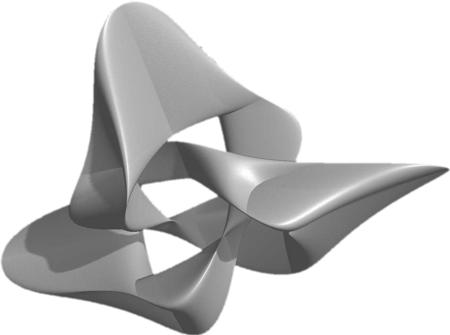
ChiralChirality /kaɪˈrælɪtiː/ is a property of asymmetry important in several branches of science. The word chirality is derived from the Greek χείρ (kheir), "hand", a familiar chiral object. A More perhaps.
I didn’t realize just how deeply we were entwined until the severing came.
And that made me think, painfully, about the words we hear at weddings: “til death do us part.”
How romantic it sounds in the bright shimmer of celebration.
But when death finally comes and does its parting work…
it’s not romantic.
It’s traumatic.
It’s tragic.
Living those vows to their very end taught me something:
you cherish the “til death” part precisely because the “death” part is unbearable.
Still, I want you to understand something important
this work is not about grief.
Grief was the catalyst, yes.
It was the propellant that launched me into the deep.
But it was never meant to be the destination.
Too often, stories like mine become monuments to suffering.
They become contests of pain whose loss was heavier, whose sorrow more profound.
I didn’t want that.
I still don’t.
I wasn’t left helpless just aimless.
And there’s a difference.
Fortunately or unfortunately, my early training had prepared me for exactly this kind of terrain.
I don’t want anyone to cry for me because I was lost.
I want you to rejoice with me because I found my way back.
The places inside me that needed healing were places only I could walk through.
It wasn’t a proud “lone wolf” refusal of help
It was simply the truth:
Nobody saw the world from my angle, so their advice, however well-meant, would always be skewed.
I respect psychology.
I see it as a valuable tool, one lens through which to examine ourselves.
But it’s just that: a lens, limited by the light the observer can perceive.
If the observer only sees black and white, then my vibrant, magenta-colored emotions have to be repainted , often inaccurately to fit within their frame of “wellness.”
Take comfort:
I never progressed far enough to earn any clinical diagnosis.
(Technically, I’m still sane. Please, take that as a joke, not as a confidence booster.)
In truth, psychology is a necessary, but partial map
the way Algebra is a necessary but partial glimpse of all mathematics.
It gets you somewhere, but not everywhere.
And I had places to go that no textbook, no talk therapy office, no tidy five-step program could chart.
So I set out not just to survive grief, but to reclaim life.
What I discovered along the way was that life itself, even in its turbulence, follows patterns.
Currents and constants, vectors and vessels, frequencies and faith all swirling just beneath the surface.
Not as abstract concepts, but as real, living forces that could be learned, navigated, and even partnered with.
In the end, I didn’t just find my way back.
I found a map, and a language that could carry others, too.
And that’s where this story truly begins.