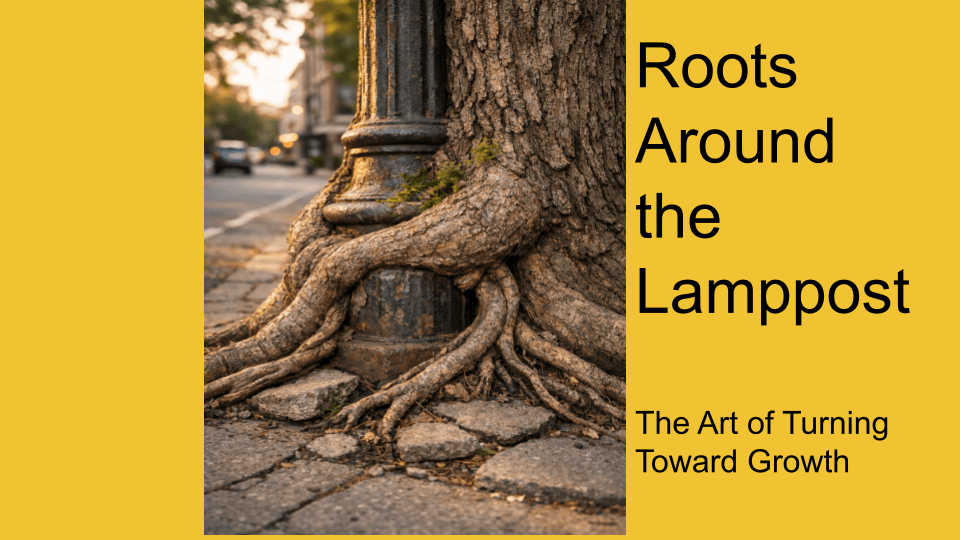
Roots Around the Lamppost
The Art of Turning Toward Growth
Psychological Edaphoecotropism
There’s a kind of beauty you only notice when you slow down. An old lamppost on a city sidewalk.
A mature tree whose roots have wrapped themselves around its base. Metal and bark fused, not in battle, but in agreement.
The tree did not push the lamppost away.
It did not stop growing.
It simply turned.
In botany, this kind of growth is called edaphoecotropism: the tendency of roots to alter their direction in response to soil conditions and obstacles, growing toward what nourishes life, even when the path is blocked.
I use that word to describe something deeply human. I call it psychological edaphoecotropism.
What Is Edaphoecotropism?
In plants, edaphoecotropism is not about defiance.
Roots don’t “fight” rocks, pipes, or posts. They listen to pressure, moisture, and resistance, then adjust.
They curve.
They wrap.
They reroute.
The goal isn’t to conquer the obstacle. The goal is to keep growing. That quiet intelligence is what first caught my attention. Because when you’ve lived long enough, you start to realize:
Most of life’s obstacles aren’t removable.
They’re structural.
Loss.
Trauma.
Limitations.
Other people’s choices.
Your own.
You don’t always get to clear the ground. But you can choose how you grow in it.
Psychological Edaphoecotropism
Psychological edaphoecotropism is the human version of that turning. It’s what happens when instead of asking,
“Why is this here?” you begin asking, “Where can I grow from here?”
It doesn’t deny pain.
It doesn’t romanticize hardship.
Roots don’t enjoy hitting metal.
But they also don’t stop. They find nourishment in new directions.
They build strength around what cannot be moved.
And in time, the very shape of the obstacle becomes part of their form.
When I look back over my life, I don’t see a straight trunk.
I see bends.
Twists.
Detours.
I see a shape formed by what I had to grow around. And instead of feeling deformed by it, I’ve come to see something else:
The turn itself became my beauty.
Roots Around the Lamppost
That’s why the image of roots around a lamppost stays with me. It’s not a story about injustice, even though injustice may be present. It’s not a story about rage, even though rage would be understandable.
It’s a story about continuation.
The tree did not let the lamppost decide whether it would live.
It simply refused to let it decide how. That’s the heart of psychological edaphoecotropism.
Not erasing the lamppost.
Not pretending it isn’t there.
But choosing growth anyway.
Two Ways of Responding to Obstacles
In the study of tropisms, there’s another useful word: aphercotropism.
While edaphoecotropism is about turning toward nourishing conditions, aphercotropism describes growth that turns away from something harmful.
Both are intelligent.
Both are necessary.
Some things you grow through.
Some things you grow away from.
In human terms:
- There are pains you integrate.
You learn to live with them, shape around them, let them deepen you. - And there are dangers you must distance yourself from.
Patterns, people, environments that cannot be made fertile no matter how much care you give them.
Psychological edaphoecotropism is about knowing the difference.
Not every obstacle is a lamppost. Some are cliffs.
Wisdom is learning when to curve…and when to change direction entirely.
I don’t spend much time on aphercotropism here because this work is not about moving away but onward.
It’s about regrowth.
Why This Matters
We live in a culture that often treats healing as subtraction.
Remove the trauma.
Erase the past.
Fix the flaw.
But life doesn’t really work that way. You don’t get to uproot your history.
You grow with it.
And if you’re paying attention, you’ll notice something humbling:
Many of the qualities you value most in yourself : your resilience, your creativity, your insight, your compassion didn’t come from perfect soil. They came from the turns.
Psychological edaphoecotropism doesn’t ask you to be grateful for harm. It asks you to be honest about what you’ve become in response to it.
Not as a badge.
Not as a wound.
But as a form.
An Invitation
Roots Around the Lamppost is not about blaming lampposts. It’s about learning to see your own bends without shame.
Where did you have to turn?
What did you grow around?
What in your life looks twisted, but is actually strong?
When you start asking those questions, something shifts. You stop measuring yourself by how straight you grew.
You start honoring how faithfully you kept reaching for life.
That is psychological edaphoecotropism.
Not perfection.
Not escape.
Just this: The quiet, stubborn intelligence of choosing to grow.

What is Science to You?

The Fallacy of 100 Percent

The Number Seven: A Journey
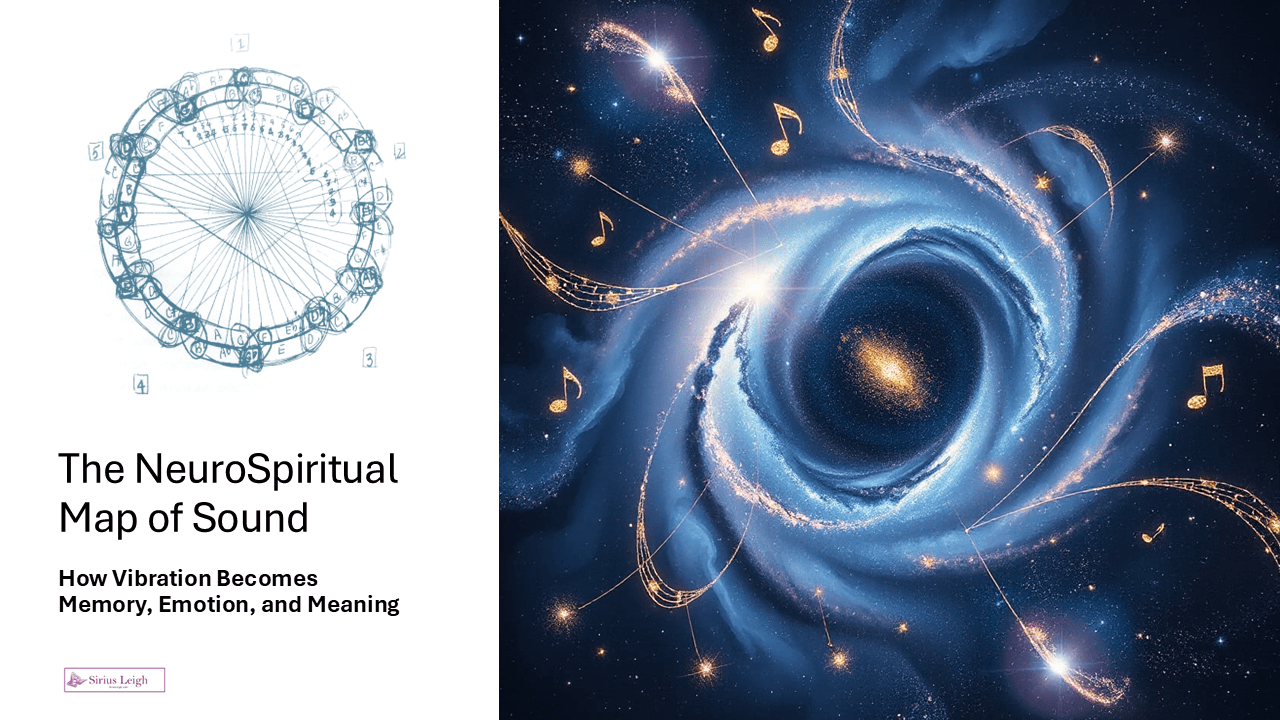
The Neurospiritual Map of Sound