
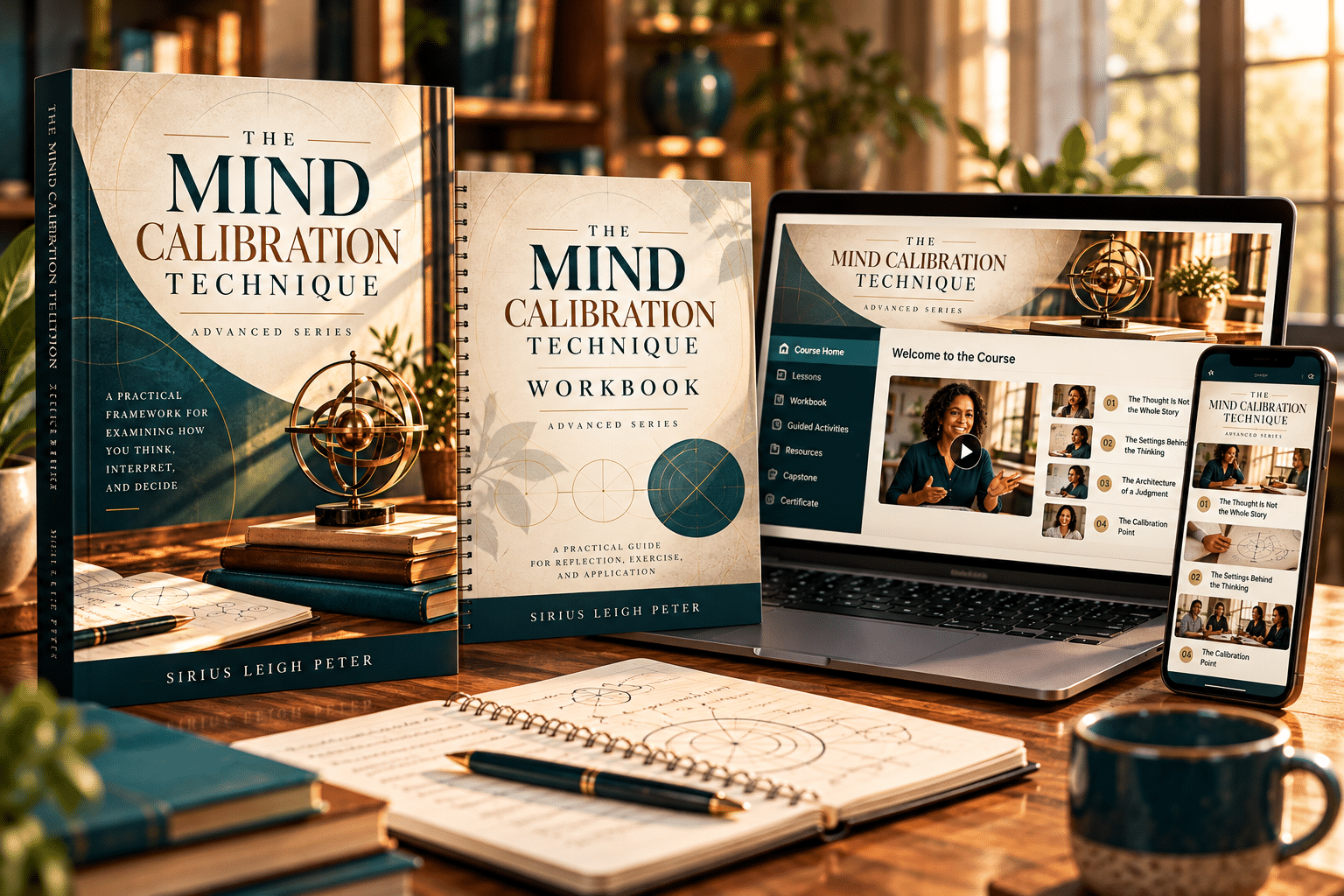
THE MIND CALIBRATION TECHNIQUE
The thought is not the whole story.
You’ve been told to think positively, change your perspective, and choose a better attitude.
But a thought doesn’t appear in a vacuum.
What you notice, what you assume, what you remember, and how you interpret an experience all influence the conclusions you reach.
What if the next step in mastering your thoughts isn’t simply changing what you think, but examining how your thinking is configured?
Welcome to the Mind Calibration Technique.
For those exploring the Law of Attraction, manifestation, faith or other practices of mental mastery, mind calibration provides an essential foundation.
Distraction, competing concerns, and unexamined assumptions can pull attention away from intended goals and undermine consistent effort.
Before attempting to direct your thinking toward a desired outcome—or applying mental techniques to influence another person—you must first develop a clearer understanding of your own mind.
Mind calibration begins with self-mastery: learning to examine your thoughts, recognize what redirects your attention, and bring your thinking into greater alignment with your intentions.
Beyond mindset. Into mind settings.
We often describe ourselves through familiar labels: optimistic or pessimistic, confident or uncertain, open-minded or close-minded. But these labels tell us relatively little about how we arrived at a particular conclusion.
Mind Calibration invites you to examine the configurations beneath your thinking. You can change your mindset and still operate from the same mind settings.
Mind calibration is the process of examining those settings, identifying what is out of alignment, and making deliberate adjustments.
Before you attempt to master a technique, learn to examine the mind that will be using it.
Mindset: What do I think?
Your beliefs, attitudes, expectations, and habitual perspectives influence how you approach an experience.
Mind settings: How is my thinking configured?
The assumptions, interpretive habits, attention patterns, and internal rules that influence what you notice and how you make sense of what happens.
Mind calibration: How well does my interpretation fit?
The deliberate process of examining your assumptions, evaluating your conclusions against available evidence, and reconsidering your interpretations when circumstances warrant it.
Together, these concepts provide a framework for investigating your thinking rather than accepting every conclusion at face value.
What can mathematics teach you about the way you think?
This is where the approach takes a different turn.
Mathematics extends beyond arithmetic and numerical calculations. It provides ways to examine relationships, identify patterns, represent structures, and explore how elements interact.
Applied to self-reflection, this perspective offers a way to investigate the relationships between experience, interpretation, judgment, and response.
You don’t need to be a mathematician or have advanced mathematical knowledge. Nor is this numerology.
The mathematics informs the approach; your own thinking provides the material for inquiry.
The experience also makes room for philosophical exploration, lived experience, and the search for meaning. Whether you approach the word inspired through intellectual curiosity, spiritual reflection, or both, you are invited to participate in the inquiry rather than simply accept a prescribed answer. The goal isn’t to force your mind into a predetermined shape. It’s to learn how to examine the shape your thinking has already taken.
Inside the Advanced Series
01 · The Thought Is Not the Whole Story
Explore the difference between an event and your interpretation of it. Identify what happened, what you noticed, and what you concluded.
02 · The Settings Behind the Thinking
Investigate how assumptions, expectations, attention, and interpretive habits influence the meaning you assign to an experience.
03 · The Architecture of a Judgment
Use a math-inspired perspective to map the relationships between experience, interpretation, assumptions, judgment, and response.
04 · The Calibration Point
Apply the method to a real-life situation. Examine your original interpretation, consider the available evidence, and construct your personal Mind Calibration Map.
Don’t just learn the concept. Put it to work.
The Mind Calibration Technique combines instructional material with guided activities, personal reflections, and a final capstone project.
This is an opportunity to move beyond passive learning and begin examining your own thinking.
- Instructional material
- Guided activities and reflections
- Prompts and exercises that connect the concepts to your own lived experience.
- Your Mind Calibration Map
- A practical exercise for examining how an experience became a judgment and considering alternative interpretations.
- 30 days of course access
- Certificate of completion
Who is this experience for?
Mind Calibration is for curious people who want to explore their thinking more deeply.
Perhaps you’ve worked on your mindset but still wonder why certain patterns persist. Perhaps you’re navigating a new chapter of life and want to examine how your assumptions influence your choices. Perhaps you’re drawn to the intersection of mathematics, philosophy, spirituality, and human experience. Or perhaps you simply enjoy discovering a different way to look at something you thought you already understood.
You don’t need to arrive with a problem to solve.
Curiosity is a great starting point!
The Calibration Point
Mastery of thought does not mean controlling every thought that enters your mind. It means developing greater discernment about how you interpret, evaluate, and act on your thoughts.
An experience and your interpretation of it are not necessarily the same thing. A compelling conclusion is not automatically a well-supported conclusion. And a familiar pattern is not always the whole picture.
Mindset is a beginning. Mind settings open another inquiry. Mind calibration gives you a way to investigate.
Your thoughts need not be unquestioned authorities. They can become subjects of inquiry, too.
Welcome to the Mind Calibration Technique: Advanced Series
Master Your Thoughts. Calibrate Your Mind.
An inspired approach to moving beyond mindset and examining the settings that shape your thinking.