Semantic Dimensionality
The property of language in which a word, phrase, or symbol carries multiple simultaneously valid layers of meaning depending on context, discipline, orientation, or interpretive position. In Mathematical Phenomenology & Hermeneutics (MPH), semantic dimensionality recognizes that meaning is not always flat or singular, but can behave more like geometry: expanding, shifting, or refracting across different conceptual domains without becoming incorrect.
For example, words such as irrational, imaginary, chaos, or real possess one meaning in ordinary language and another within mathematics. Advanced discernment requires the ability to recognize which semantic dimension is active, and when multiple dimensions may be operating simultaneously.
One of the first things readers should understand about Mathematical Phenomenology and Hermeneutics is that certain words do not remain flat.
In higher levels of the work, language behaves more like geometry than vocabulary. Meaning shifts depending on orientation, context, discipline, and the position from which the observer encounters the word. What appears contradictory at one angle may become structurally coherent from another.
This is not an attempt to obscure meaning, it’s an exercise in discernment.
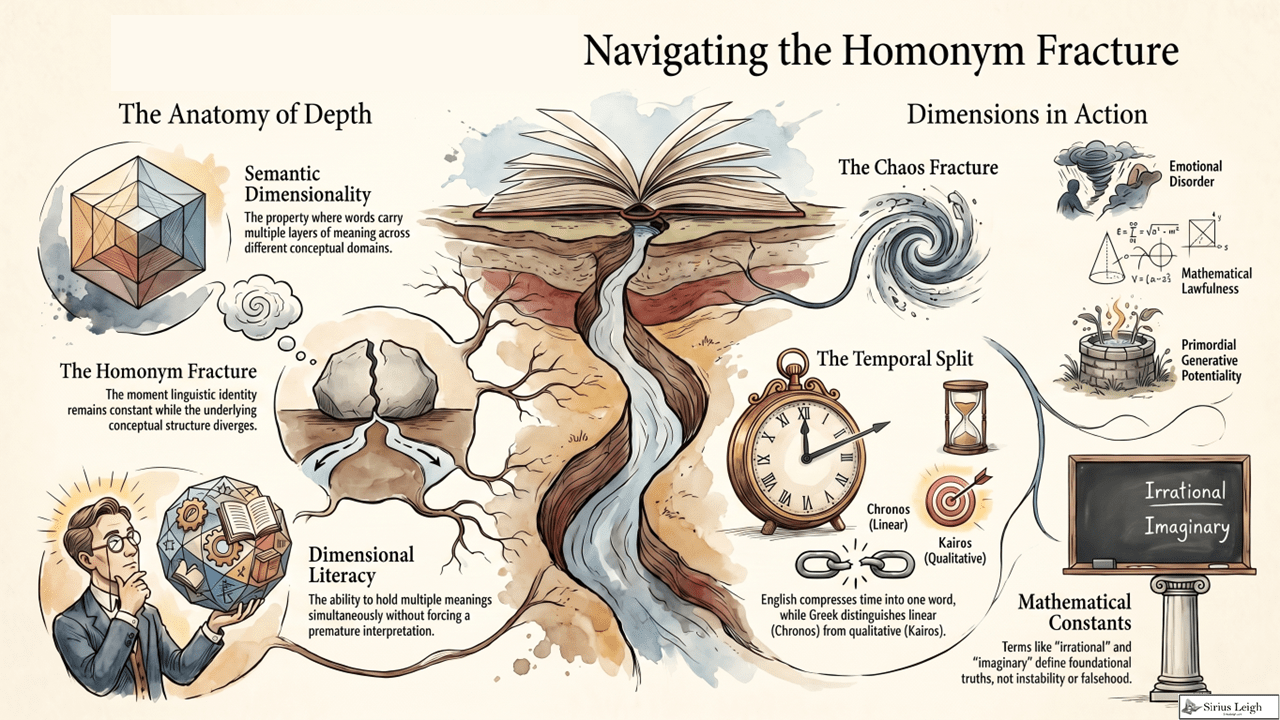
Within MPH, this phenomenon is called a homonym fracture: the moment when a single word carries multiple simultaneously valid meanings that cannot be fully collapsed into one another without losing dimensionality.
A homonym fracture occurs when language reaches the boundary where ordinary speech and mathematical language overlap but do not perfectly align. The words sound identical, yet the conceptual structures beneath them differ dramatically. This is not rare. Human beings navigate these fractures constantly, usually without noticing.
Consider the word chaos.
In ordinary language, chaos implies total disorder. Confusion. Collapse. Meaninglessness. A room destroyed by children. A society unraveling. A mind in turmoil.
But mathematics fractures the meaning immediately.
In chaos theory, chaos does not mean absence of structure. It refers to systems so sensitive to initial conditions that tiny variations produce dramatically different outcomes while the system itself still obeys deterministic laws.
The system is lawful.
The predictability is what collapses.
A hurricane forms. Weather shifts. A tiny divergence compounds until outcomes separate exponentially. The structure remains active even when forecasting fails. This is a radically different understanding of chaos than the everyday emotional use of the word.
But the fracture deepens further.
In many ancient cosmologies and theological traditions, chaos did not merely mean disorder. Chaos often referred to the primordial void: the unformed deep, the undifferentiated state preceding structure and creation itself.
Not evil.
Not nonsense.
Potentiality before organization.
Suddenly one word contains three simultaneous realities:
- emotional disorder,
- mathematically lawful unpredictability,
- and primordial generative void.
The word did not fail, our interpretive depth did.
This is why discernment becomes critical inside MPH. The task is not merely to define words but to recognize which meaning-domain is active before prematurely collapsing interpretation.
The same fracture appears with the word irrational.
In ordinary conversation, irrational suggests instability, emotional imbalance, or unreliable thinking. But mathematically, irrational simply means a number cannot be fully expressed as a repeating ratio.
π is irrational.
So is √2.
And yet both remain completely dependable. Entire civilizations stand upon geometry governed by irrational constants. Circles do not collapse because π refuses repetition. Our structures remain upright because of √2.
The emotional meaning modern language assigns to irrationality does not exist inside the mathematics itself.
The same thing happens with imaginary.
In ordinary speech, imaginary means fake.
But mathematically:
…is not real however it still exists. The imaginary number system is indispensable to physics, engineering, wave mechanics, and multidimensional mathematics. The imaginary axis extends mathematical space beyond what can be represented on the real number line alone.
Again, the word remains identical while the structure beneath the word changes completely.
This becomes especially important when reading ancient texts such as the 27 Mental Way-Weigh Stations through modern English translations.
Many ancient languages possessed conceptual distinctions that English compresses into a single word. Over centuries this creates interpretive flattening, where multiple dimensions of meaning collapse into one familiar modern term.
Time is a perfect example.
In English we simply say time.
But ancient Greek distinguished between:
- chronos
- and kairos.
Chronos refers to measurable, sequential, linear time:
minutes,
years,
duration,
progression,
calendar movement.
It is the form of time modern consciousness usually prioritizes because modern life is heavily organized around clocks, schedules, productivity, and deadlines.
Kairos refers to something entirely different.
Kairos is appointed time. Ripened time. The critical moment when conditions align. It is qualitative rather than merely quantitative. A season. A fulfillment. A threshold.
As in – The Time is Now.
Modern readers unconsciously approach ancient texts through chronos because modern language conditions us to hear time linearly.
But most ancient theories of consciousness operate more through kairos than chronos :
- the fullness of time,
- due season,
- appointed moments,
- revelation,
- harvest,
- alignment,
- emergence.
The English translation may still simply say time while the conceptual geometry beneath the word differs radically.
This is why “Aid the Ear” becomes necessary within Mathematical Phenomenology and Hermeneutics.
Discernment is not merely hearing words correctly.
It is recognizing:
- which coordinate system is active,
- which meaning-domain is operating,
- and whether multiple meanings are functioning simultaneously.
Without this capacity, interpretation collapses.
Readers unconsciously import modern emotional assumptions into mathematical structures, theological language, symbolic systems, and ancient texts where those assumptions may no longer apply.
The result is not misunderstanding because information was absent, but because semantic dimensionality was flattened too quickly.
This is one reason higher-level MPH work intentionally exercises the reader’s ability to hold multiple meanings simultaneously without panic. Readers must learn to resist premature semantic closure to extract truth.
Not every word should immediately collapse into its most socially familiar definition. Sometimes multiple meanings remain active at once.
This is not confusion, it’s dimensional literacy.
And perhaps this has always been true of consciousness itself.
Grief can wound and transform simultaneously.
Chaos can conceal hidden structure.
The irrational can remain lawful.
The imaginary can produce measurable effects.
Time can move linearly and seasonally at once.
Depending on where you are standing.
The purpose of the homonym fracture is not to get lost in meanings.
The purpose is to learn how to navigate them.
And perfect your Semantic Dimensionality