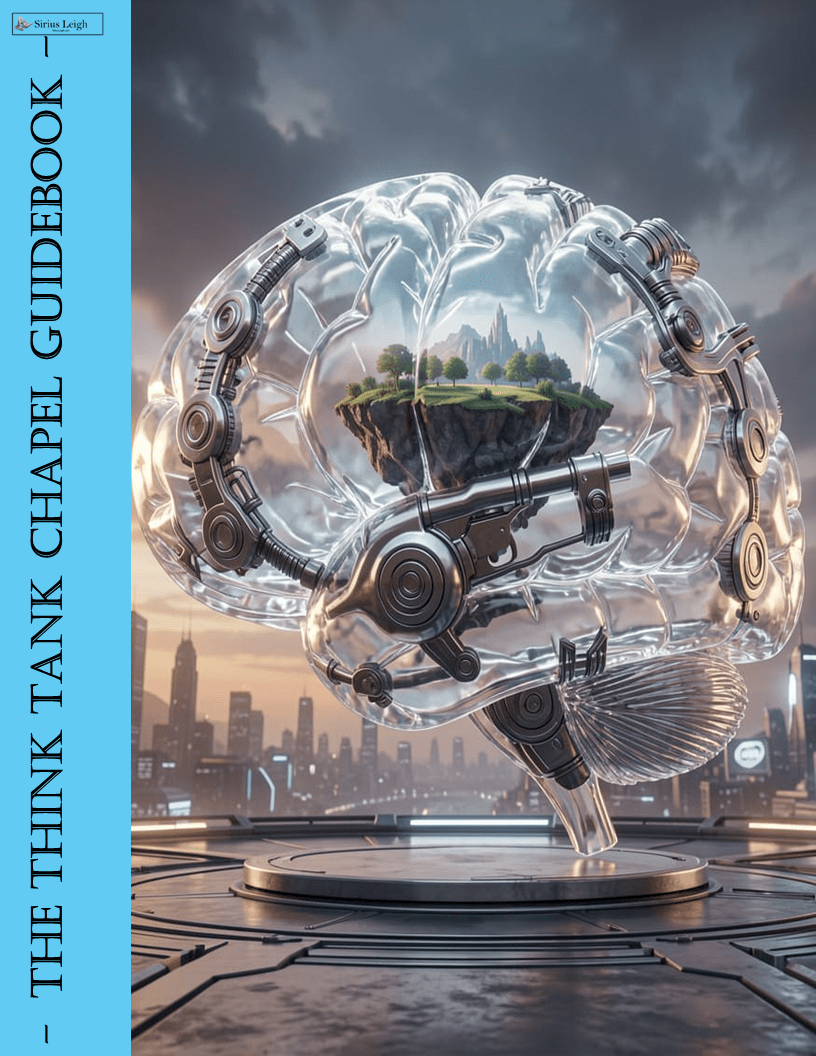
The Think Tank Chapel Guidebook
FREE -Start Reading Now The TT Chapel Guidebook – An Aition Aition (noun): From the Greek aitia, meaning cause or origin.An aition is an explanation …

Overview
FREE -Start Reading Now
The TT Chapel Guidebook – An Aition
Aition (noun): From the Greek aitia, meaning cause or origin.
An aition is an explanation of why something exists in the form it does.
It does not merely describe a thing; it reveals the necessity that brought it into being.
There comes a point when intelligence without calibration becomes exhaustion. Not because the mind lacks power.
Because it lacks coordinates.
The Think Tank Chapel Guidebook was not written to provide information. Information is everywhere. It was written because highly perceptive minds often move without a map. They think fast. They feel deeply. They detect distortion instinctively. Yet they are rarely given a structural instrument that shows them where they are before asking them to move.
The Think Tank Chapel (and the broader architecture it lives within) exists in the space where separate components meet. Mathematics and mysticism. Physics and scripture. Myth and lived experience. For some, this convergence can initially register as mixed metaphor. It is not. It is comparison and contrast under disciplined examination.
What may appear as reductionism is inspection at an atomic level – isolating structure to understand integrity.
What may appear as lack of faith is Truth in Performance – belief subjected to stress-testing rather than sentiment.
This guidebook exists because participation without orientation produces noise.
The Think Tank Chapel is not a curriculum. It is a vessel in motion. And no one boards a moving vessel without first locating north.
The locator framework – the X, Y, and Z axes – was developed as a response to a recurring gap: brilliant cognition that could sense the curve of thought but was handed only flat categories in return. Conventional models compress arcs into labels. This structure restores dimensionality.
The X-axis addresses alignment : not morality as performance, but coherence as structure.
The Y-axis addresses energy: not inspiration, but measurable force and displacement.
The Z-axis addresses perception: not surface reaction, but dimensional depth.
This framework also offers a glimpse into the creative and algorithmic processes operating behind the visible work. It reveals how synthesis is built, how correlations are tested, and how intersections are evaluated before conclusions are allowed to stand. Not for spiritual cosplay, but structure.
Calibration precedes participation because movement without coordinates is drift. And drift, over time, feels like self-betrayal. This Guidebook exists as an orienting turn, a way of placing the mind within its own geometry before asking it to travel.
And once that is clear, synergy no longer looks like chaos. It’s recognizable as design.
The Think Tank Chapel isn’t a spiritual playground but a moving vessel. And movement requires direction.
Curriculum
- 3 Sections
- 6 Lessons
- Lifetime
- Module 1The Language; Human beings are not moved by logic alone; beneath our polished reasoning lives a reactive, meaning-hungry core that does not respond to proof but to symbol. Literary devices such as allusion, allegory, and parable are not decorative; they function as bridges, allowing language to reach parts of the psyche that structured precision cannot access. When the goal is not technical compliance but human survival and integration, symbolic language becomes not indulgence, but necessity.3
- Module 2Mathematical Phenomenology & Hermeneutics (MPH) is the study of an interior landscape of the mind. Drawing from classical phenomenology: which investigates how reality appears through consciousness, and hermeneutics the tradition of interpreting meaning. this discipline treats mathematical thought as a lived encounter.2
- Module 3Reflection to Reverberation Now glimpse the five currents that powered this work: Alchemy, Psychology, Power, Sacred Texts, and Revelations. Each current, represented by a set of books, was not simply a source of knowledge , it was a way–weigh station: a checkpoint for navigation and an invitation to explore. This path offers a bird’s-eye view of the terrain to demonstrate how thinking , and being , can evolve when spiritual hunger meets disciplined inquiry. When ancient truth meets modern mind. When numbers, names, and the numinous are no longer divided.1
Requirements
- None
You May Like
Think Tank Chapel Series
Think Tank Chapel Series What is a think tank?A place where ideas are tested, sharpened, and refined. Not small talk. Not casual musings. Serious thinking,...
Course Features
- Lectures 6
- Quiz 0
- Duration Lifetime access
- Skill level Beginner
- Language English
- Students 326
- Certificate No
- Assessments Yes