Five Letters to God
This collection has been moved to the July 2025 issue of Iqiniso & the Science of Spirit
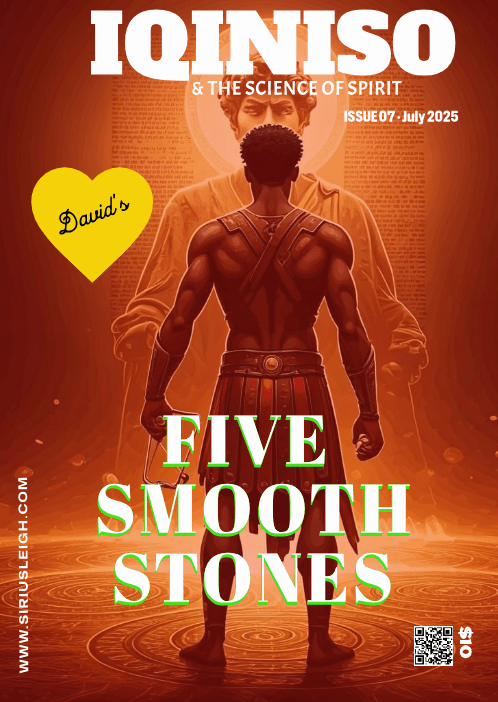
About David’s 5 Smooth Stones: Five Letters to God
This series of letters explores the spiritual and intellectual journey of Sirius Leigh Peter, inspired by the story of David and Goliath.
Each letter reflects on modern challenges, faith, and the intersection of scripture and mathematics, offering revelations aimed at dismantling false gods like distraction, fear, and imitation.
- First Letter: Scroll-Happy Saints A call to authenticity in faith, challenging believers to move beyond superficial displays of devotion and truly engage with God’s voice.
- Second Letter: The Banquet is Ready An invitation to embrace transformation and fellowship with God, lamenting how many reject the feast for crumbs of worldly distractions.
- Third Letter: The One Who Taught Me to Build A personal testimony of meeting God as the Carpenter, learning to build with divine order and understanding, rather than seeking easy salvation.
- Fourth Letter: The Cost of Attention A reflection on the sacredness of attention, urging readers to invest their focus in God’s blueprint rather than fleeting digital distractions.
- Fifth Letter: The Faith That Builds A powerful message on the partnership between belief and logic, showing how faith and structure work together to move mountains and build a life aligned with God’s design.
Each letter is a stone aimed at illusions that keep people small, reminding us that the real power lies in clarity, intention, and faith.
The main themes in the letters to God include:
- Faith and Action: The letters emphasize the importance of living out faith through intentional actions, not just superficial expressions or performances. Faith is portrayed as a force that requires direction and movement.
- Belief and Logic: The author explores the harmony between belief and logic, showing how they are collaborators rather than opposites. Mathematics is used as a metaphor for divine order and structure.
- Spiritual Authenticity: The letters challenge spiritual cosplay – performing faith for appearances rather than embodying it authentically. The author calls for genuine transformation and commitment to God.
- Divine Invitation: The recurring theme of God’s open invitation to fellowship and transformation is central. The author laments why many reject this call, choosing distractions or superficiality over depth and connection.
- Overcoming Giants: Inspired by the story of David and Goliath, the letters focus on confronting modern “giants” like distraction, fear, and imitation, using spiritual tools and revelations.
- Building with God: The author reflects on her journey of learning to build with God’s guidance, using both faith and structure. She highlights the importance of understanding divine patterns and applying them in life.
- Attention as Sacred: The letters stress the holiness of attention, urging readers to focus on God and His Word rather than being consumed by fleeting distractions.
- Grief and Growth: The author shares her personal struggles and growth, showing how pressure and pain can lead to revelations and deeper faith.
These themes collectively call for a deeper, more intentional relationship with God, rooted in authenticity, understanding, and action.
Mathematics also plays a profound role in the letters, serving as a bridge between faith and logic. The author uses mathematics to uncover divine patterns, symmetry, and structure in the world, viewing it as a language through which God communicates. She highlights how mathematical concepts like ratios, Fibonacci sequences, and geometry reflect the order and design of creation, revealing God’s presence in the unseen architecture of life.
Through this lens, mathematics becomes a tool for understanding the blueprint of scripture and the universe, helping her move beyond superficial faith to a deeper, actionable belief. It’s not just about numbers, it’s about seeing God’s fingerprints in the logic and precision that hold the world together. This approach challenges the misconception that faith and science are incompatible, showing how they can work together to build a life of clarity, intention, and divine alignment.